2026-10-06 · Paul Hayes
What R-Value Do Pole Barn Walls and Roofs Need in Oklahoma?
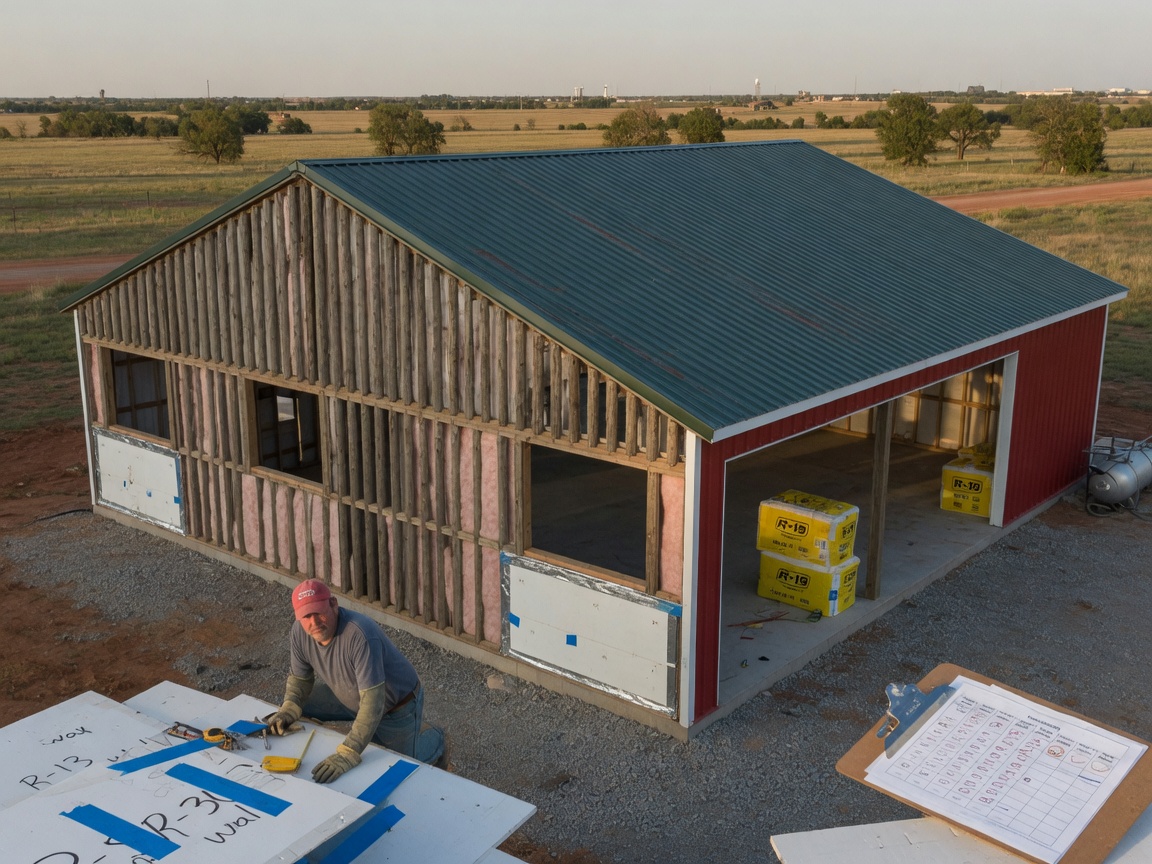
In Tulsa County, pole barn walls need R-13 to R-19 while roofs require R-30 to R-38 to manage the region's warm humid summers and cold winters with frequent severe thunderstorms.
Wall R-Values for Oklahoma Pole Barns
Pole barns across Tulsa, including neighborhoods like Maple Ridge and Greenwood, often feature metal walls that conduct heat quickly. An R-13 to R-19 rating slows heat transfer during winter cold snaps and reduces cooling loads in summer. Builders in Cherry Street and the Pearl District commonly see older metal structures from the 1970s that benefit from added insulation layers to reach these targets. Higher R-values in this range also help control moisture migration through seams when thunderstorms bring heavy rain. Local crews note that R-19 works best on north-facing walls exposed to prevailing winds from the northwest.
Roof R-Values and Heat Dynamics
Roofs demand R-30 to R-38 because rising heat escapes fastest through the ceiling in winter and solar gain builds up in summer. In Jenks and Bixby, where many agricultural pole barns sit on flat terrain, installers add thicker layers to prevent ice damming during rare freezes. The 30 to 38 range also limits condensation on the underside of metal panels when humidity spikes above 70 percent. Crews working near the BOK Center or Route 66 Historical Village often combine this insulation with proper venting to maintain performance through Tulsa's thunderstorm season.
Climate Impacts on Insulation Performance
Warm humid summers in Tulsa County push condensation risks inside pole barns, especially near the Gathering Place and Philbrook Museum of Art where humidity lingers after storms. Cold winter nights require walls and roofs to hold heat without creating cold spots that lead to dripping. Severe thunderstorms common from spring through fall can drive wind-driven rain under eaves, making higher R-values paired with vapor barriers essential. In Owasso and Broken Arrow, crews adjust R-value targets upward by 3 to 5 points on buildings near open fields where wind exposure increases.
Spray Foam Application Considerations
Closed-cell spray foam delivers the target R-values in a single pass on metal surfaces common throughout Downtown Tulsa and Utica Square. It adheres directly to purlins and girts without sagging over time. For buildings used seasonally, condensation control becomes critical when R-30 roof insulation meets humid air. Installers measure existing metal thickness and gap sizes before calculating material needs to hit exact R-numbers without over-application.
Comparing Options for Local Conditions
Best insulation types for Tulsa pole barns include spray foam for its air-sealing ability in older metal buildings found in Brookside. Fiberglass batts may reach R-19 in walls but leave gaps that allow moisture movement during humid periods. In Sperry and Skiatook, where barns often store equipment year-round, the higher R-values on roofs prevent energy loss that would otherwise occur through unsealed seams. Local operators inspect soil drainage around each site because poor grading can raise interior humidity and reduce effective R-performance over time.